
Federal Prison Release Paths
No BOP prison, U.S. Marshals Service detention facility, or other federal correctional site was verified inside Washington County. These systems matter only when a named person entered federal custody. A sentenced BOP prisoner may leave prison for the community, supervised release, a residential placement, or another authority. Departure from BOP does not prove freedom from all custody or legal control.
A federal court order supplies the legal basis for release. The BOP record supplies the agency status and release date. A movement to a state jail, an immigration authority, or another system can end BOP custody while confinement continues. For a Washington County connection, do not use the local Detention Center as a federal locator. Ask it only about a local booking or a transfer that began in county custody.
| Federal channel | What it establishes | What it cannot prove alone |
|---|---|---|
| BOP Inmate Locator | BOP status, release date, location, and identity fields. | Whether another authority assumed custody. |
| Federal docket or order | The court action and legal authority affecting custody. | The exact physical exit if processing occurred later. |
| Actual detention facility | The carried-out movement or release event. | The final disposition of every federal charge. |
| USMS record | Pretrial, court-custody, or transport context when available. | A public nationwide release result, because none exists. |
Confirm Federal Inmate Releases
The BOP Inmate Locator is the first search for a sentenced federal prisoner. It generally contains records from 1982 forward. Use a BOP register number or another supported federal identifier when available. A name search can be narrowed with age, race, and sex, but those traits should be used only to distinguish a lawful match. Older records may require the National Archives.
- Search by the strongest federal identifier, or enter the person’s first, middle, and last names.
- Compare name, register number, age, race, sex, release date, and listed location.
- Read RELEASED, Not in BOP Custody, UNKNOWN, and IN TRANSIT as BOP-specific terms.
- Open the federal docket and locate the release, sentence, or custody order tied to the same person and case.
- Contact the actual holding facility when the docket and locator do not settle the physical movement.
A past Release Date with no facility means the person is no longer in BOP custody on the listed date. It does not rule out custody elsewhere. UNKNOWN may mean the confinement term has not been set, including some pretrial, unsentenced, or civil-commitment matters. IN TRANSIT describes movement. It is not release.
Custody limit: A BOP release status answers only whether BOP still holds the person. Check the court and any receiving authority.
Federal Prison Release Records
BOP locator results are a fast public record, not the entire file. Additional federal prison records may be requested through BOP Freedom of Information Act resources. Privacy and law-enforcement exemptions can limit disclosure. Keep the request narrow: identify the person, register number, relevant date range, facility, and the admission, release, or movement record sought.
The federal court is the better source for a signed release order, judgment, or docket event. BOP answers federal prison custody. The court answers legal authority. If a Washington County jail movement led into federal custody, WCSO may hold the local transfer entry, but that county record does not replace the later federal release record.
Note: Send a records request to the agency that owns the field instead of sending the same broad request to every office.
Federal Release Status Meanings
The official BOP locator field explanation defines the scope of its results and cautions that release from BOP custody does not settle every other custody system.
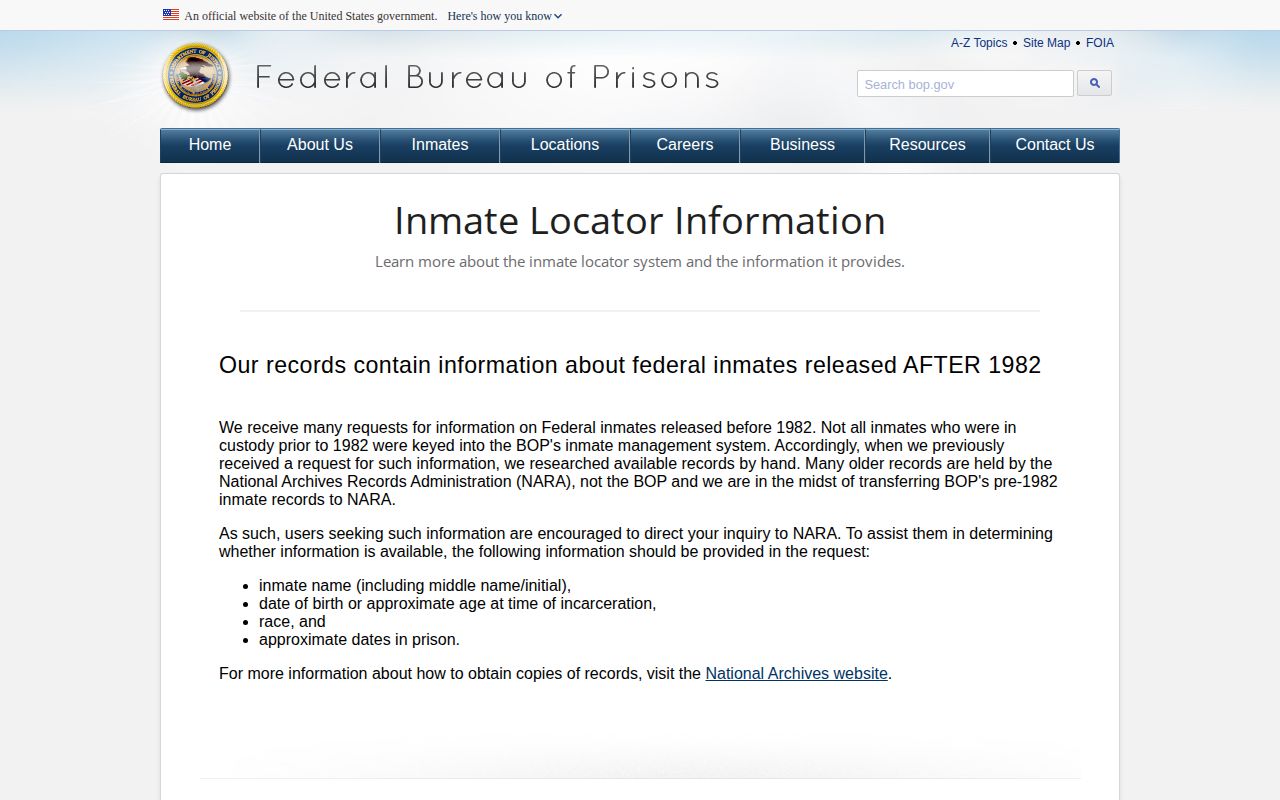
The captured source supports a narrow reading of RELEASED and Not in BOP Custody. The federal docket, release order, and receiving-system record remain necessary when the next destination matters.
- Released
- Out of BOP custody on the recorded date, not necessarily free of all custody.
- In transit
- Moving between locations or authorities, not discharged.
- Supervised release
- A federal court-ordered community term that can continue after prison.
- Register number
- The stable BOP identifier used to separate similar names.
Washington County USMS Releases
The U.S. Marshals Service is a separate federal path. It handles federal pretrial custody, court custody, and transport. A person may remain under a federal court order while housed in a contract or other detention site. After conviction, USMS may deliver the person to BOP. After acquittal or a release order, the actual facility carries out the discharge. That sequence may never appear as a completed BOP sentence release.
USMS publishes no equivalent public released-prisoner locator. Search the federal docket first. Identify the detention site named in the case or custody paperwork, then confirm the event there. A pretrial detainee may leave a BOP-hosted location under Marshals control without a final BOP record that answers the court-custody question.
The USMS FOIA route is a limited fallback. It accepts requests without an initial submission fee, but privacy and law-enforcement exemptions can restrict what is released. Ask for a specific record and period. Do not expect USMS to create a release narrative or disclose protected prisoner information.
U.S. Marshals Service
Federal pretrial, court-custody, and transport records
Washington County Federal Release Timeline
Build the federal timeline from identifiers and dated events. The BOP register number is the strongest link to a sentenced-prison record. A federal case number ties the person to the docket. The actual facility ties the legal order to the place that carried out custody. If the matter began with a Washington County arrest, the local booking or movement number anchors the earlier county episode. A name or photograph alone is not enough to connect these systems.
A typical sentenced path can run from federal judgment, to USMS transport, to BOP designation and admission, to a computed date, and finally to release or supervised release. A pretrial path differs. USMS may control the person through another detention site until the court orders release, acquits the person, or directs transfer after conviction. A BOP name result may then be missing or may describe only one temporary location.
Write down the date each source was checked. Locator dates can change after a sentence or credit recalculation. Docket entries may also precede physical processing. When a court orders release but the facility still reports custody, ask whether another hold exists or processing is incomplete. When BOP reports release but another authority shows admission, describe a transfer between custodians.
Negative searches have limits too. A pre-1982 federal prison record may fall outside the ordinary locator. A misspelled name or missing identifier can hide a record. A USMS-controlled pretrial detainee may not have the sentenced BOP history a searcher expects. Use each source’s stated scope before concluding that no federal custody or release event exists.
Washington County Federal Transfers
A person can disappear from Washington County Detention because of a transfer to federal or immigration custody. That local exit is not a community release. Call Detention at 252-793-1107 and ask whether the movement record identifies a receiving authority. Then switch to the federal system named in the record. BOP covers sentenced federal imprisonment, while USMS covers many pretrial and transport episodes.
NC SAVAN and NCDAC are not federal substitutes. SAVAN covers participating county and state reporting, and NCDAC excludes federal custody. Likewise, a BOP result cannot confirm an unrelated Washington County booking. The Washington County released inmate search explains how to begin with the last custodian and reconcile the county, court, state, and federal timeline.
Release dates can also change after a sentence or credit recalculation. When the exact legal basis matters, use the federal order. When the exact physical movement matters, use the custodian record. When the result shows another authority, follow that system rather than calling the person free.
Keep record requests separate. Ask BOP for its own admission, location, sentence, or release record. Ask USMS for a defined pretrial or transport record when the Marshals controlled that stage. Ask the federal court for the signed order and docket. This division respects each custodian’s role and makes later conflicts easier to explain.
Match the same person and episode at every step. A court name without a case number, a locator name without a register number, or a facility call without a custody date can attach the wrong event. Stable identifiers and a simple chronology make the final release conclusion much stronger.
Note: No federal detention facility was verified in Washington County, so confirm the actual holding location before making travel plans.